
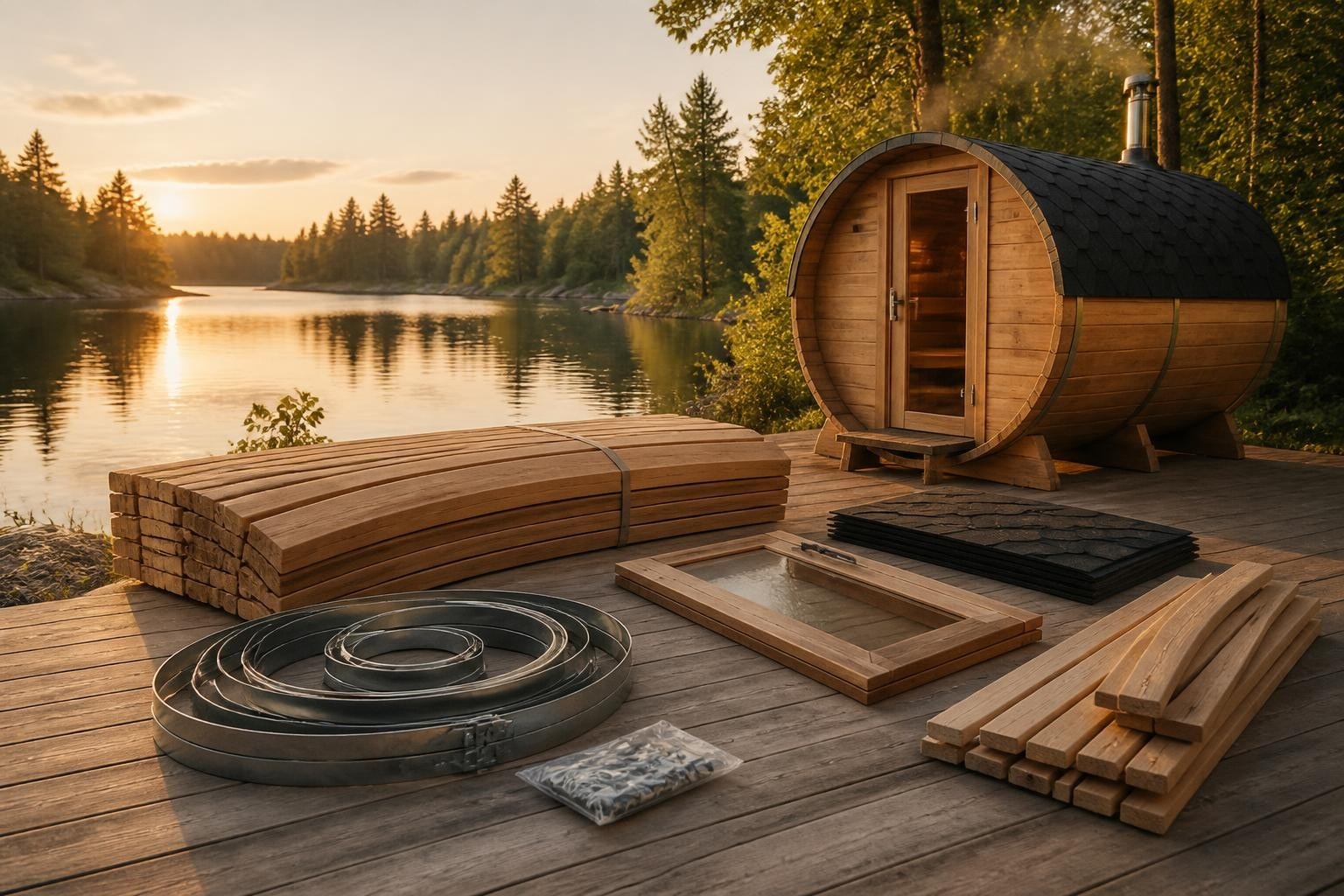
A barrel sauna kit delivers the components needed to build a cylindrical outdoor sauna on your property. Most kits include pre-cut curved cedar staves, metal tension bands, a tempered glass door, roof panels, benches, and assembly hardware. You provide the foundation, electrical work, and heater installation. The barrel shape sheds water naturally and heats efficiently because warm air circulates inside a smaller volume compared to a rectangular cabin.
I've built saunas on Lake Saimaa since I was young enough to swing a hammer. The barrel design is practical, not decorative. It works.
What Arrives in a Barrel Sauna Kit
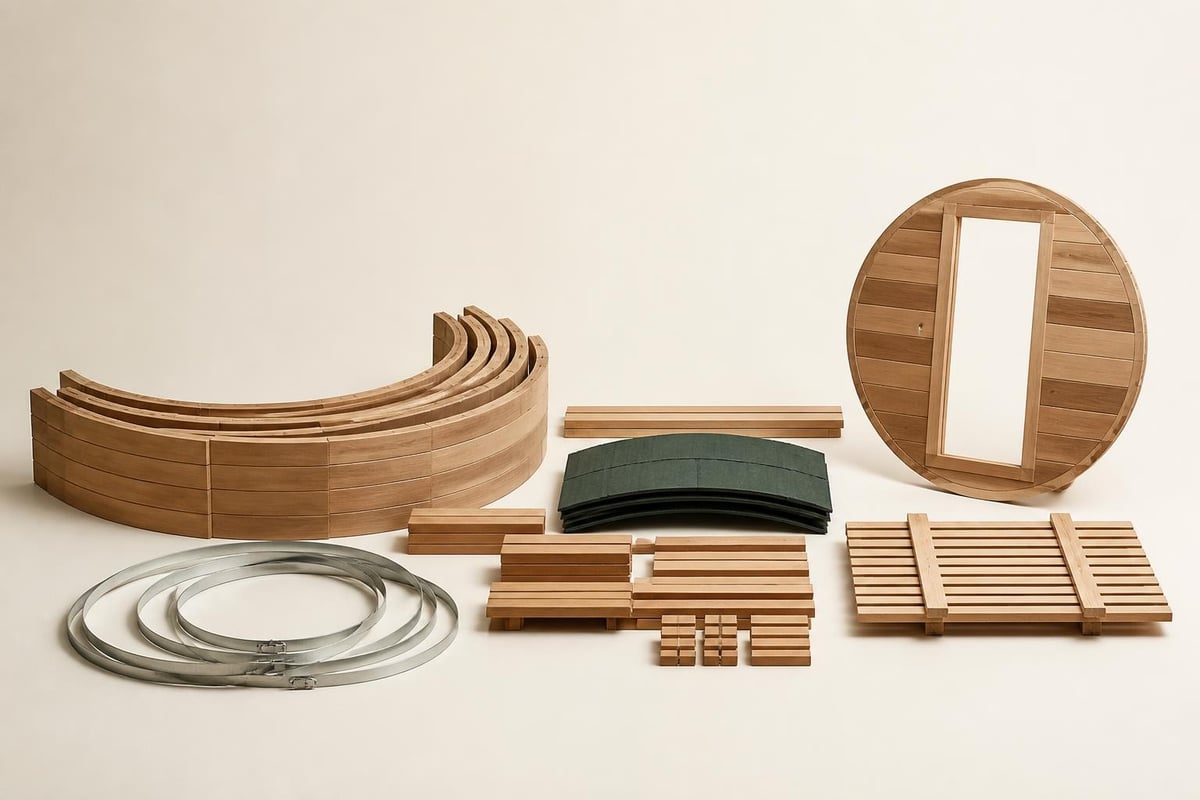
A typical barrel sauna kit ships in sections, not as a finished structure. You receive tongue-and-groove cedar staves that form the curved walls, stainless steel bands that hold tension around the barrel, and a door assembly with tempered glass.
Most kits include:
- Pre-cut wall staves with tongue-and-groove edges
- Metal tension bands (usually 4-6 depending on length)
- Roof panels or shingles
- Bench supports and slats
- Door frame and glass door
- Assembly hardware (bolts, screws, brackets)
- Ventilation components (adjustable vents)
The heater is almost never included. You select and purchase that separately based on the sauna's interior volume. A 6x8 foot barrel typically needs a 6-8 kW electric heater.
Foundation materials are your responsibility. The kit assumes you've prepared a level gravel bed, concrete pads, or deck surface. Proper foundation preparation prevents settling and door misalignment.
Wood Species and Grade
Most North American barrel sauna kits use Eastern White Cedar or Western Red Cedar. Both resist moisture and insect damage without chemical treatment.
| Wood Type | Characteristics | Common Use |
|---|---|---|
| Eastern White Cedar | Light color, mild scent, stable in temperature shifts | Premium kits, colder climates |
| Western Red Cedar | Reddish tone, stronger aroma, naturally oils resist rot | Standard kits, moderate climates |
| Nordic Spruce | Light weight, minimal scent, used in Finland | Rare in North America |
Cedar contains natural oils that slow decay. The wood expands and contracts with humidity, which is why the metal bands include tensioning bolts. You tighten them after the first few heating cycles as the wood settles.
Comparing Barrel Sauna Kit Types
Not all kits are built the same way. The differences affect assembly time, long-term maintenance, and how well the sauna holds heat.
| Kit Type | Assembly Method | Typical Price Range | Best For |
|---|---|---|---|
| Pre-fab panels | Bolt together large sections | Higher | Fast setup, less DIY skill needed |
| Stave-by-stave | Stack individual curved boards | Moderate | Traditional build, adjustable fit |
| Hybrid | Panels + individual boards | Moderate to high | Balance of speed and customization |
Pre-fab panel kits arrive with wall sections already assembled. You position them and bolt the sections together. Assembly takes one to two days with two people.
Stave-by-stave kits require you to stack each curved board into the cradle supports, sliding tongue into groove. The process takes longer but lets you adjust fit as you go. If a board is slightly warped, you can compensate.
Insulated vs. Non-Insulated Barrels
Standard barrel sauna kits have no insulation between the inner and outer walls. The single layer of cedar provides minimal insulation value. Heat retention depends on wood thickness and how well the door seals.
Insulated barrel kits include foam board or mineral wool between an inner and outer cedar shell. Proper insulation reduces heat-up time and energy cost in climates where winter temperatures drop below 20°F.
The trade-off is cost and complexity. Insulated kits can cost 30-40% more and require more careful assembly to prevent thermal bridging.
Choosing the Right Barrel Sauna Kit
Start with capacity. A 6-foot diameter barrel with 6-8 feet of length seats two to three people comfortably. An 8-foot length seats four if benches run the full interior.
Key selection criteria:
- Interior volume determines heater size and heat-up time
- Wood thickness (usually 1.5 to 2 inches) affects durability
- Band quality (stainless steel holds tension better than galvanized)
- Door design (full glass provides light, wood-frame doors insulate better)
- Roof style (shingle vs. metal, overhang length)
Measure your available space before ordering. Barrels need clearance on all sides for air circulation and maintenance access. Plan for at least 18 inches around the perimeter.
Check local building codes. Some municipalities classify outdoor saunas as accessory structures requiring setback from property lines. Electrical work for the heater needs inspection in most areas.
Heater Sizing for Barrel Saunas
A barrel sauna heats faster than a cabin sauna with equivalent floor space because the interior volume is smaller. The curved walls also keep warm air circulating near the benches instead of rising to a peak.
Calculate interior volume in cubic feet. Multiply length × width × height, then multiply by 0.65 to account for the barrel's curved shape. A 6×8 foot barrel has approximately 187 cubic feet.
You need roughly 1 kW of heater power per 50 cubic feet. A 187 cubic foot barrel requires a 4-5 kW heater minimum. Most builders install a 6 kW unit for faster heat-up and better temperature recovery after throwing water on the stones.
Stone mass matters more than heater wattage for authentic löyly. A heater with 40-50 pounds of stone holds enough thermal energy to produce steam without temperature crash. Smaller stone chambers cool too quickly.
Assembly Process and Realistic Timelines
Manufacturers claim you can build a barrel sauna kit in a weekend. That's optimistic unless you have carpentry experience and help.
Realistic assembly timeline:
- Foundation prep (1-2 days): Level gravel base or concrete pads
- Cradle assembly (2-4 hours): Build the support structure that holds the barrel
- Wall stacking (4-8 hours): Stack staves or position panel sections
- Band installation (1-2 hours): Wrap and tension metal bands
- Roof attachment (2-4 hours): Install roof panels and shingles
- Door and bench install (2-3 hours): Hang door, install bench supports and slats
- Electrical rough-in (hired electrician, 4-6 hours): Run circuit, install heater
- Finishing details (1-2 hours): Vents, trim, hardware adjustments
Plan for three to four full days if you're moderately handy. First-time builders often need five to six days. Detailed assembly guides walk through each step with photos.
The heaviest lift is positioning the walls before the bands go on. Two people can manage, but three makes it easier. Once the bands tighten, the structure becomes rigid.
Common Assembly Mistakes
The most frequent error is starting assembly before the foundation is perfectly level. Even a half-inch slope causes the door to bind and prevents bands from seating evenly.
Other issues to avoid:
- Overtightening bands before all staves are seated
- Skipping the vapor barrier under the floor
- Installing the heater too close to walls (fire code violations)
- Not allowing wood to acclimate before assembly in humid climates
Wood movement is normal. Cedar expands when it absorbs moisture and contracts when it dries. The bands compensate for this, but you need to check tension monthly during the first year.
Long-Term Ownership and Maintenance
A barrel sauna kit requires less maintenance than a cabin-style sauna because water runs off the curved roof naturally. Snow and leaves don't accumulate.
You'll need to:
- Tighten bands every few months during the first year, then annually
- Seal or stain exterior wood every 2-3 years if you want to preserve color
- Check roof shingles for lifting or gaps after heavy storms
- Clean benches with mild soap and water, never harsh chemicals
- Empty and clean the drain pan if your model includes one
The interior cedar darkens over time from heat and steam. This is normal. Some owners sand benches lightly every few years to refresh the surface, but it's not required.
Barrel sauna maintenance is simpler than most outdoor structures because there are no complex joints where water can penetrate. The metal bands protect the wood edges.
Heating Costs and Energy Use
A well-built barrel sauna uses less energy than a comparable cabin sauna. The smaller interior volume and efficient shape mean the heater runs for less time to reach temperature.
Typical heating cycle: 30-45 minutes from cold start to 160-180°F. Once at temperature, the heater cycles on and off to maintain heat. A one-hour session uses 3-6 kWh depending on outside temperature and insulation.
In cold climates, insulated barrel saunas reduce heating time by 20-30% and maintain temperature more consistently. The extra upfront cost pays back through lower electricity use.
Growing Up on Lake Saimaa
I learned sauna on Lake Saimaa in Eastern Finland, where my family kept a wood-heated barrel sauna at the water's edge. We heated it every Saturday afternoon in winter, sometimes twice daily in summer when relatives visited. The barrel shape was practical for that shoreline climate because snow and ice slid off without damaging the roof. After löyly, we walked down wooden steps directly into the lake, a routine my grandfather followed for sixty years before modern research had a name for it.
For homeowners considering a barrel sauna for their backyard, the Canadian Timber Serenity MP Barrel Sauna from LeisureCraft brings that same Eastern White Cedar construction and simple reliability that works in cold climates. It's designed for straightforward assembly and daily use with an electric heater.
Barrel Sauna Kit Questions
How long does a barrel sauna kit last?
Twenty to thirty years with basic maintenance. Cedar naturally resists rot, and the metal bands protect the structure from weathering. Regular band tensioning and occasional exterior sealing extend lifespan. Quality kits with thicker cedar and stainless bands last longer than budget models.
Can I install a wood-burning heater in a barrel sauna kit?
Yes, but you need to modify the kit for chimney clearance and add fire-resistant wall protection. Most kits are designed for electric heaters. Wood-burning requires cutting a roof penetration, installing a chimney, and meeting fire code clearances. Electric is simpler and safer for most DIY builds.
Do I need a building permit for a barrel sauna kit?
Depends on your municipality. Many jurisdictions treat saunas under 200 square feet as accessory structures that don't require permits. The electrical work usually needs inspection regardless of structure size. Check with your local building department before starting assembly.
What's the smallest barrel sauna kit available?
Four feet in diameter and six feet long, seating one person. These compact units work for small yards but heat up quickly and cool down fast because of limited thermal mass. A 5x6 or 6x6 barrel provides better temperature stability and still fits most residential lots.
How do I prevent the barrel sauna from rolling or shifting?
The cradle supports hold the barrel in place and prevent movement. Secure the cradle to your foundation with anchor bolts or lag screws. On gravel bases, the cradle's weight usually provides enough stability, but windy locations benefit from ground anchors. Never place a barrel sauna on grass or dirt without a solid base.
A barrel sauna kit offers an efficient path to authentic outdoor sauna if you're willing to invest assembly time and prepare a proper foundation. The curved design heats quickly and sheds weather naturally, though it requires regular band maintenance and exterior care. At RecoSauna, I answer questions about kit selection, heater sizing, and assembly from personal experience growing up with this tradition. If you're ready to discuss which barrel sauna fits your yard and climate, Ask Petri About Your Sauna.
Share:
Traditional Sauna for Home: Full Guide (2026)
Contrast Therapy: The Finnish Sauna & Cold Plunge Ritual