
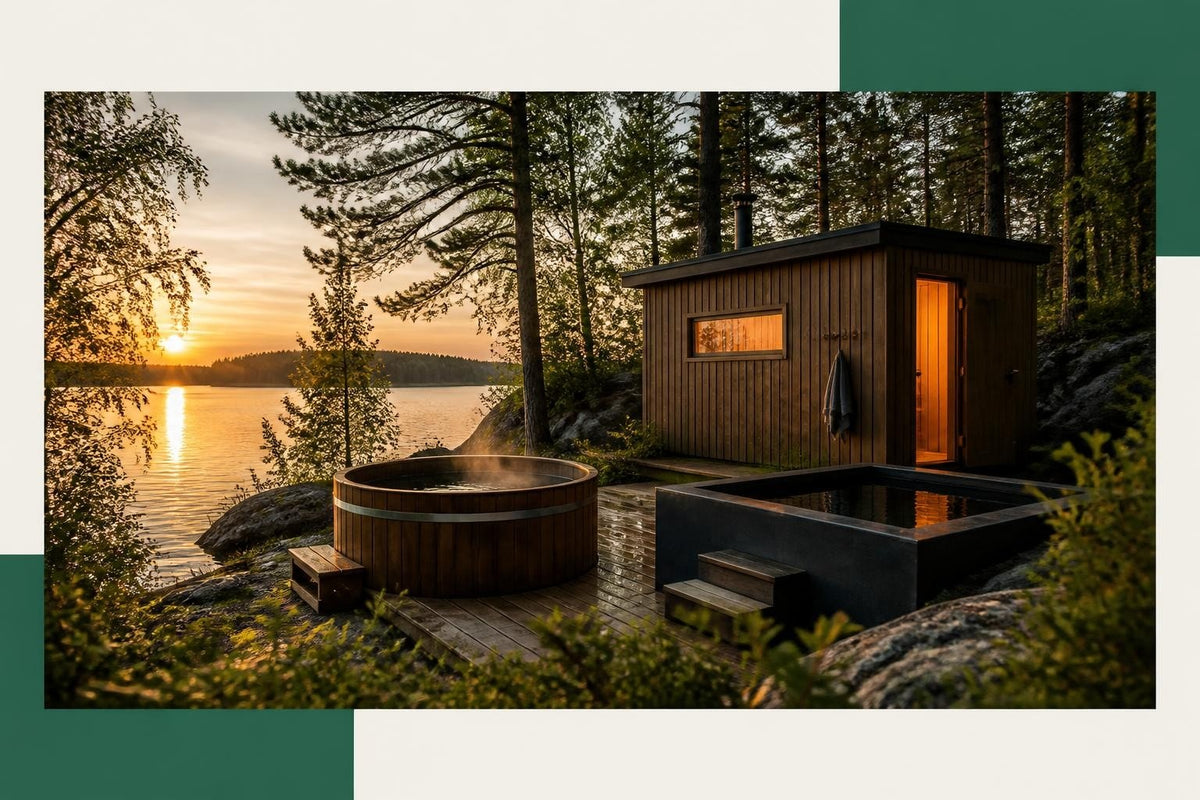
An outdoor spa traditionally means a heated hot tub on a patio or deck. The term has broadened since 2020. Today it can describe anything from a jetted acrylic shell to a minimalist cold plunge beside a sauna, all built for recovery in your backyard. The category expanded as homeowners looked beyond passive soaking toward active temperature contrast. Both approaches have a place. Knowing what you want determines which you install.
What Qualifies as an Outdoor Spa
An outdoor spa is any structure or vessel designed for therapeutic water immersion installed outside a dwelling. Most jurisdictions define it as a pool-like basin with water heated above ambient temperature, distinct from a swimming pool by its smaller capacity and warmer operating range.
The Uniform Swimming Pool, Spa and Hot Tub Code provides model standards used across North America. It covers water temperature limits, circulation, filtration, sanitation, and barrier requirements. Local amendments vary but the framework is consistent.
Traditional outdoor spas use electric or gas heaters, jets for hydrotherapy massage, and chemical sanitizers like chlorine or bromine. Water temperature typically runs between 100°F and 104°F. Acrylic shells seat two to eight people and include pumps, filters, and control panels.
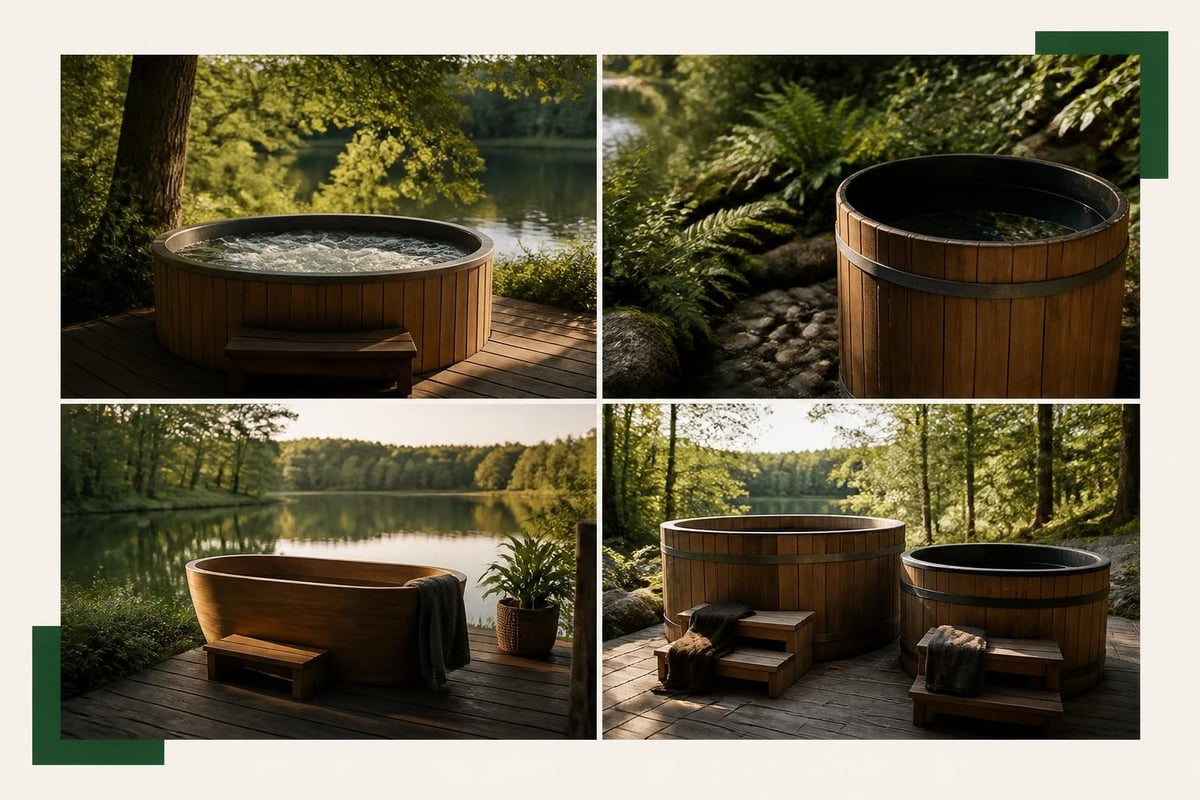
Modern interpretations include:
- Cold plunge tubs filled with water chilled to 40°F to 55°F
- Soaking tubs without jets, heated or unheated
- Contrast therapy setups pairing hot and cold vessels
- Natural pools with biological filtration instead of chemicals
Each version serves a different purpose. Hot spas promote relaxation and passive recovery. Cold plunges stimulate circulation and alertness. Pairing both creates the cycle Finns have practiced for two millennia.
Traditional Hot Tubs vs. Contrast Therapy Systems
| Feature | Traditional Hot Tub | Contrast Setup (Sauna + Plunge) |
|---|---|---|
| Primary Use | Passive soaking, jet massage | Active heat exposure, cold immersion |
| Water Temperature | 100-104°F | Hot (sauna dry heat 150-195°F), Cold (40-55°F) |
| Maintenance | Daily chemical testing, weekly shock, quarterly drain | Plunge: weekly drain/refill or chiller system; Sauna: minimal (wipe benches) |
| Installation | Electrical (240V 50A typical), concrete pad, access panel | Sauna: 240V or wood-fired; Plunge: 120V if chilled, hose-fill if ice |
| Footprint | 6x8 ft average | Sauna 6x6 ft + plunge 4x5 ft (can be separated) |
A traditional hot tub keeps water at a steady temperature for drop-in use. You step in, sit, soak. Jets massage. You exit when relaxed. It's a low-effort routine good for evenings and socializing.
A contrast therapy system involves deliberate heat stress followed by cold immersion. You heat your body in a sauna, then plunge into cold water. The cycle repeats two or three times. The practice requires intention but research shows association with improved circulation and mental clarity.
Traditional hot tubs need year-round chemical maintenance. Algae, bacteria, and biofilm grow in warm standing water. You test pH and sanitizer levels daily, add shock weekly, and drain quarterly. Filters need cleaning every month. Covers slow heat loss but must be removed to access the water.
Cold plunges operate differently. Water below 60°F discourages microbial growth. You can drain and refill weekly without chemicals, or use a chiller with minimal sanitizer. Sauna maintenance is even simpler: wipe benches after use, sweep the floor, empty the bucket. No water chemistry. No pump service.
Space and Layout Considerations
An outdoor spa consumes permanent backyard space. Traditional hot tubs need a level reinforced surface, electrical service, and privacy screening. Most municipalities require four-sided barriers with self-closing gates if children live in or visit the home.
Contrast setups need similar planning but different adjacencies. Place the sauna and plunge within a short walk, ideally three to ten feet apart. Walking between them while your body shifts from heat to cold is part of the cycle. A paved or gravel path works. Grass becomes mud in winter.
If you plan to use the system year-round, consider wind exposure and snow access. A sauna sheds snow from a peaked roof. A plunge tub needs a clear approach even in February. Locate both where you'll use them in January, not just July.
Backyard sauna ideas show real installations across North America. Climate matters. A system that works in Vermont needs different details than one in Oregon or Ontario.
Site Requirements and Code Compliance
Every outdoor spa installation must meet electrical, structural, plumbing, and safety codes. Requirements vary by jurisdiction but share common elements.
Electrical service is the first constraint. A traditional hot tub typically requires a dedicated 240V circuit with 40 to 60 amp capacity. Wiring must be GFCI-protected and run in conduit. Distance from your main panel determines cost. A 60-foot underground run in conduit costs more than a 15-foot run.
Electric sauna heaters draw 30 to 60 amps at 240V depending on cabin size. Wood-fired heaters need no electrical service, only a chimney and spark arrestor. Cold plunge chillers usually run on 120V or 240V circuits with lower amperage. If you install all three components, coordinate electrical loads with a licensed electrician before ordering equipment.
Setback rules govern how close you can place a spa to property lines, structures, and utilities. Many cities require five feet from the rear and side property lines, ten feet from overhead power lines, and three feet from gas meters. Consult your local building department before site prep.
Barrier and cover requirements apply to any vessel capable of holding more than 18 inches of water. The ADA guidance on accessible design also affects commercial or shared-use installations. Residential setups typically need a fence or lockable cover.
Hot tub covers must meet ASTM F1346 standards in many jurisdictions. Pool and spa cover safety rules illustrate how local health departments enforce those standards. A compliant cover supports 485 pounds and includes locking straps to prevent child access.
Permitting and Inspection
Most regions classify an outdoor spa as an accessory structure requiring a building permit. The permit process triggers plan review, electrical inspection, and final approval. Skipping permits risks fines and complicates future home sales.
Submit a site plan showing the spa location, setbacks, electrical routing, and drainage. Include manufacturer specifications for the equipment. Plan review takes one to four weeks depending on jurisdiction workload.
After installation, schedule inspections. Electrical must be inspected before backfill. Final inspection confirms the installation meets approved plans. Keep permit records with your home documents.
Some HOAs and condo associations impose additional restrictions on outdoor spas. Review covenants before purchasing equipment.
Choosing Equipment for Climate and Use
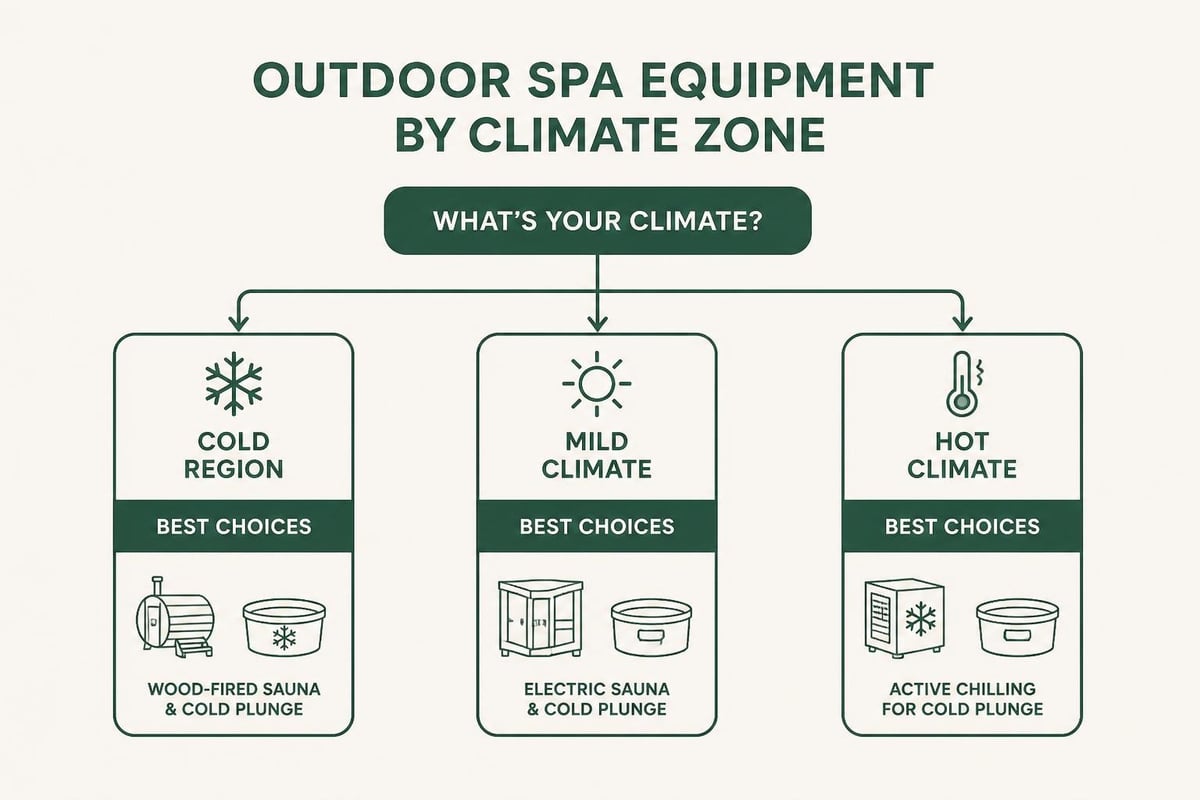
Your climate determines which outdoor spa system will work and which will frustrate you. A jetted hot tub in Minnesota runs all winter if properly insulated. The same unit in Arizona may overheat in July without shade.
Cold climate considerations (below 20°F in winter):
- Insulated cabinet and cover are essential for hot tubs
- Plumbing must be frost-protected or drained seasonally
- Sauna heaters need higher output to compensate for cold exterior walls
- Wood-fired sauna heaters excel in extreme cold (no electrical load, faster warmup)
Mild climate considerations (rarely below freezing):
- Simpler cabinet construction acceptable
- Year-round plunge use with no freeze risk
- Lower sauna heater wattage sufficient
- Electric heaters easier to site and permit than wood-burning
Hot climate considerations (summer highs above 95°F):
- Hot tubs may need cooling systems in summer
- Cold plunges require active chilling (ice alone insufficient in desert heat)
- Sauna use shifts to morning or evening to avoid midday heat
If you live where winter temperatures drop below freezing, a contrast setup with an outdoor sauna and cold plunge makes more sense than a traditional hot tub. Saunas function in any weather. Plunges work even when the water freezes over (you break the ice layer). Hot tubs can freeze and crack if power fails during a winter storm.
Heater Sizing and Heat Source
Hot tub heaters are sized by water volume and desired temperature rise. A 400-gallon tub in a cold climate needs a larger heater than a 250-gallon tub in Florida. Electric heaters range from 4 kW to 11 kW. Gas heaters deliver faster recovery but require a gas line and venting.
Sauna heater sizing depends on cabin volume and insulation. Calculate cubic feet and choose a heater rated for that range. A well-insulated 6x6x7 ft cabin holds 252 cubic feet and typically needs a 6 to 8 kW electric heater. Poor insulation or large glass areas demand higher output.
Most quality saunas in North America use Harvia heaters built in Finland. The brand has proven reliable across thousands of installations from Alaska to Texas. Stone mass matters as much as wattage. A heater loaded with 40 pounds of olivine or peridotite stone retains heat longer and produces better steam than one with 20 pounds.
Cold plunge temperature control involves either active chilling or passive ice. Electric chillers maintain steady temperature but add cost and complexity. A simple tub filled from a hose and loaded with ice works in moderate climates. In hot regions, you need refrigeration to keep water below 55°F.
Water Quality and Conservation
Traditional hot tubs consume significant water and energy. A 400-gallon tub drained quarterly uses 1,600 gallons per year just for refills, not counting evaporation losses. Chemical sanitizers add ongoing cost and environmental load.
The EPA water conservation guide provides strategies to reduce consumption. While written for commercial users, the principles apply to residential outdoor spas:
- Use covers to reduce evaporation (50-70% of heat loss occurs at the water surface)
- Optimize drain intervals by maintaining proper chemical balance
- Consider ozone or UV systems to reduce chlorine or bromine demand
- Capture backwash water for landscape irrigation where regulations allow
Cold plunges can operate with weekly drain-and-refill cycles using no chemicals if water temperature stays below 60°F. A 100-gallon plunge uses 5,200 gallons annually on a weekly refill schedule. Adding a chiller and minimal sanitizer extends water life to monthly changes, cutting annual use to 1,200 gallons.
Saunas use no water beyond what you bring in a bucket to create steam. A typical session uses one to two liters for throwing on the stones. There is no standing water, no filtration, no chemical treatment.
Drainage and Runoff
Every outdoor spa produces wastewater that must drain somewhere. Hot tub water contains sanitizers, dissolved solids, and organic matter. Local codes usually prohibit draining spa water into storm drains or directly onto neighboring properties.
Options for hot tub drainage:
- Sanitary sewer via cleanout (requires backflow prevention)
- On-site dispersal into landscaped areas if chemical levels are safe and local code allows
- Holding tank for pump-out service in restricted areas
Cold plunge water without chemicals can often be drained onto grass or landscaping. Confirm local regulations first. Some jurisdictions treat any outdoor spa equally regardless of sanitizer use.
Sauna condensation is minimal and drains through the floor naturally. A gravel bed under the sauna absorbs occasional moisture. No special drainage system is needed.
Cost and Maintenance Over Time
A traditional outdoor spa costs between $4,000 and $15,000 for the tub itself, plus $1,500 to $5,000 for electrical and site work. Annual operating cost runs $600 to $1,200 for electricity, chemicals, and filter replacements. Major component replacements (pumps, heaters, control boards) add $300 to $800 every five to seven years.
A contrast therapy setup pairs an outdoor sauna with a cold plunge. An outdoor barrel or cabin sauna ranges from $5,000 to $12,000 depending on size and heater type. A quality cold plunge costs $2,000 to $6,000 with or without a chiller. Site work and electrical add $1,500 to $4,000.
Operating cost for a contrast setup is lower. An electric sauna session uses 6 to 10 kWh. At typical residential rates that's $0.80 to $1.40 per session. A wood-fired sauna burns 15 to 25 pounds of firewood per session, costing $2 to $5 depending on local wood prices. Cold plunge with ice costs almost nothing. With a chiller, add $20 to $40 monthly for electricity.
Maintenance time differs sharply. A hot tub demands 15 to 30 minutes weekly for testing, chemical adjustments, and filter cleaning. Quarterly draining and refilling takes a full afternoon. Annual totals reach 20 to 30 hours.
A sauna and cold plunge together need about five minutes after each session: wipe the benches, rinse the bucket, sweep if needed. Drain and refill the plunge weekly (10 minutes). Annual total: under 10 hours.
Mental Health and Therapeutic Use
Research shows association between hydrotherapy and reduced symptoms of anxiety and depression. A 2024 meta-analysis on hydrotherapy and balneotherapy reviewed multiple controlled trials and found consistent patterns of improvement in mood and stress markers among participants who engaged in regular warm-water immersion.
Cold water immersion shows different but complementary effects. Controlled exposure to cold activates the sympathetic nervous system, increasing alertness and mental clarity. When paired with heat exposure in a sauna, the contrast creates a cycle that many users describe as mentally restorative.
These are associations, not proofs of causation. Individual response varies. Some people find hot soaking deeply relaxing. Others prefer the sharp focus that follows a cold plunge. The best outdoor spa setup matches your own response patterns.
Practical therapeutic applications:
- Post-workout recovery (cold plunge to reduce soreness)
- Evening relaxation (hot soak or sauna session before bed)
- Morning activation (sauna followed by cold plunge)
- Chronic pain management (warm water for joint stiffness)
- Stress reduction (regular heat exposure in a quiet space)
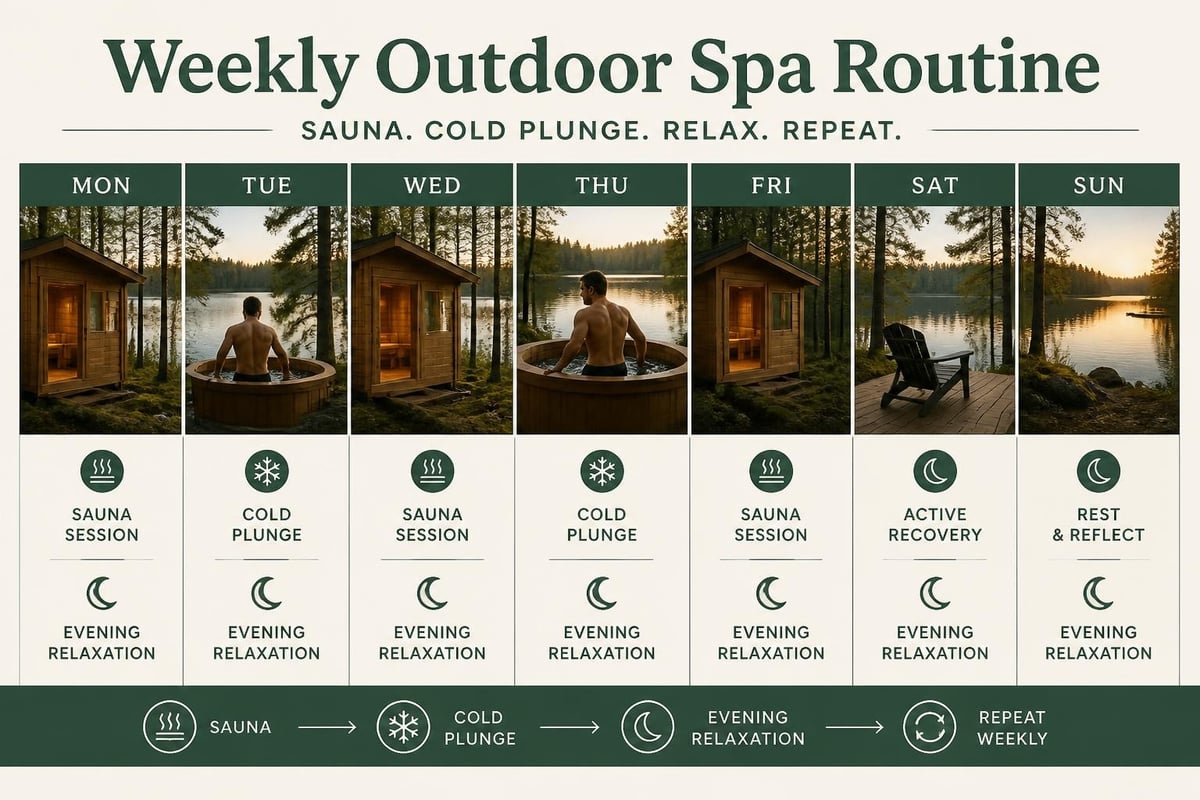
Therapeutic benefit requires regular use, not occasional sessions. Three sauna sessions per week show stronger association with cardiovascular and mental health markers than one session per month. Consistency matters more than intensity.
Building a Routine
An outdoor spa becomes useful when it fits into your day without friction. A hot tub 50 feet from your back door across a muddy lawn gets used in summer and ignored in winter. A sauna five steps from the kitchen gets used year-round.
Place your outdoor spa where you'll use it in February, not just in July. Visible from a window you look through often. Short walk from a door you use daily. Lit by a motion sensor so you don't stumble in the dark.
A sustainable routine starts simple. Ten minutes in the sauna after dinner. A one-minute cold plunge after your run. You build from there when the practice feels automatic, not like a chore.
Design Integration with Your Yard
An outdoor spa either blends into your landscape or dominates it. Neither is wrong, but the choice is yours. A traditional hot tub on a deck is intentionally visible, a social feature. A sauna tucked into a corner with evergreen screening is a private retreat.
Visibility and privacy:
Traditional hot tubs often sit on elevated decks where neighbors and passersby can see users. Screening with fences, lattice, or tall plantings creates privacy without blocking light. A pergola overhead adds shade and defines the space.
Saunas benefit from partial concealment. A cedar cabin beside a fence line or nestled into a hedge feels more like a destination than an appliance. The walk from the house to the sauna becomes part of the experience.
Pathways and surfaces:
Barefoot traffic between a sauna and cold plunge demands smooth surfaces. Pavers, smooth concrete, or fine gravel work. Avoid sharp rocks, splinters, or slippery tile. In snowy climates, choose surfaces that drain and dry quickly.
Seasonal appearance:
A traditional hot tub looks the same in winter and summer, a constant presence in your yard. A sauna surrounded by deciduous trees changes with the seasons: bright and dappled in summer, stark and sculptural in winter. Plan for how the space will look nine months of the year, not just the three when everything is green.
Lighting:
Outdoor spas used after dark need lighting. Low-voltage path lights mark the route. A single overhead fixture illuminates entry steps and controls. Inside a sauna, a shielded bulb behind a wooden grill provides soft warm light without glare. Cold plunges need no interior lighting.
Motion sensors prevent stumbling but can be too sensitive near trees. Manual switches offer more control. Solar path lights reduce wiring but may not provide enough brightness in winter.
Growing Up on Lake Saimaa
I grew up on Lake Saimaa in Eastern Finland, where sauna is not a luxury but a weekly rhythm. Every Friday evening we heated our sauna, and after the final round, we walked down to the lake. In summer, the water was calm and cool. In winter, we broke through a thin layer of ice. The shock was always the same: immediate, total, clarifying. Then back to the warm cabin, wrapped in towels, feeling like the world had reset. That cycle taught me more about recovery than any protocol ever could.
Frequently Asked Questions
Can I use an outdoor spa in winter?
Yes. Traditional hot tubs function in freezing weather if properly insulated and powered. Saunas work in any climate, actually warming faster in cold air. Cold plunges freeze over at the surface but remain usable (break the ice layer). Power outages pose the main winter risk for hot tubs, which can crack if water freezes inside plumbing.
How much does it cost to run an outdoor spa monthly?
A traditional hot tub costs $50 to $100 per month for electricity and chemicals in most climates. An electric sauna used three times weekly costs $10 to $20 monthly in electricity. A wood-fired sauna costs $15 to $30 monthly in firewood. A cold plunge with ice costs nearly nothing; with a chiller, add $20 to $40 monthly.
Do I need a permit for a backyard cold plunge?
Usually yes. Most jurisdictions classify any water-holding vessel deeper than 18 inches as a pool or spa, requiring a building permit. Permit processes vary, but expect to submit a site plan and schedule inspections. Check your local building department before installation.
How often do I need to drain a hot tub vs. a cold plunge?
Hot tubs need draining every three to four months to remove dissolved solids and refresh the water. Cold plunges without chemicals can be drained and refilled weekly. With a chiller and minimal sanitizer, monthly draining is typical. Saunas hold no standing water and require no draining.
Can I install an outdoor spa myself?
Electrical work requires a licensed electrician in most jurisdictions. Sauna assembly is straightforward for anyone comfortable with tools; most kits use tongue-and-groove panels and basic fasteners. Hot tub installation involves plumbing and electrical hookups best left to professionals. Cold plunge tubs arrive ready to place and fill, but chiller installation may require professional refrigeration service.
An outdoor spa can mean a jetted hot tub, a cold plunge, a sauna, or all three together. The right choice depends on your climate, space, and what kind of recovery fits your life. At RecoSauna, we specialize in Finnish-style saunas and contrast therapy systems built for North American backyards, with guidance from someone who grew up using them daily. Whether you're planning a single sauna or a full recovery setup, feel free to Ask Petri About Your Sauna before you commit.
Share:
Backyard Wellness: How to Turn Your Yard into a Recovery Space
Home Wellness: Build Your Recovery Space in 2026